
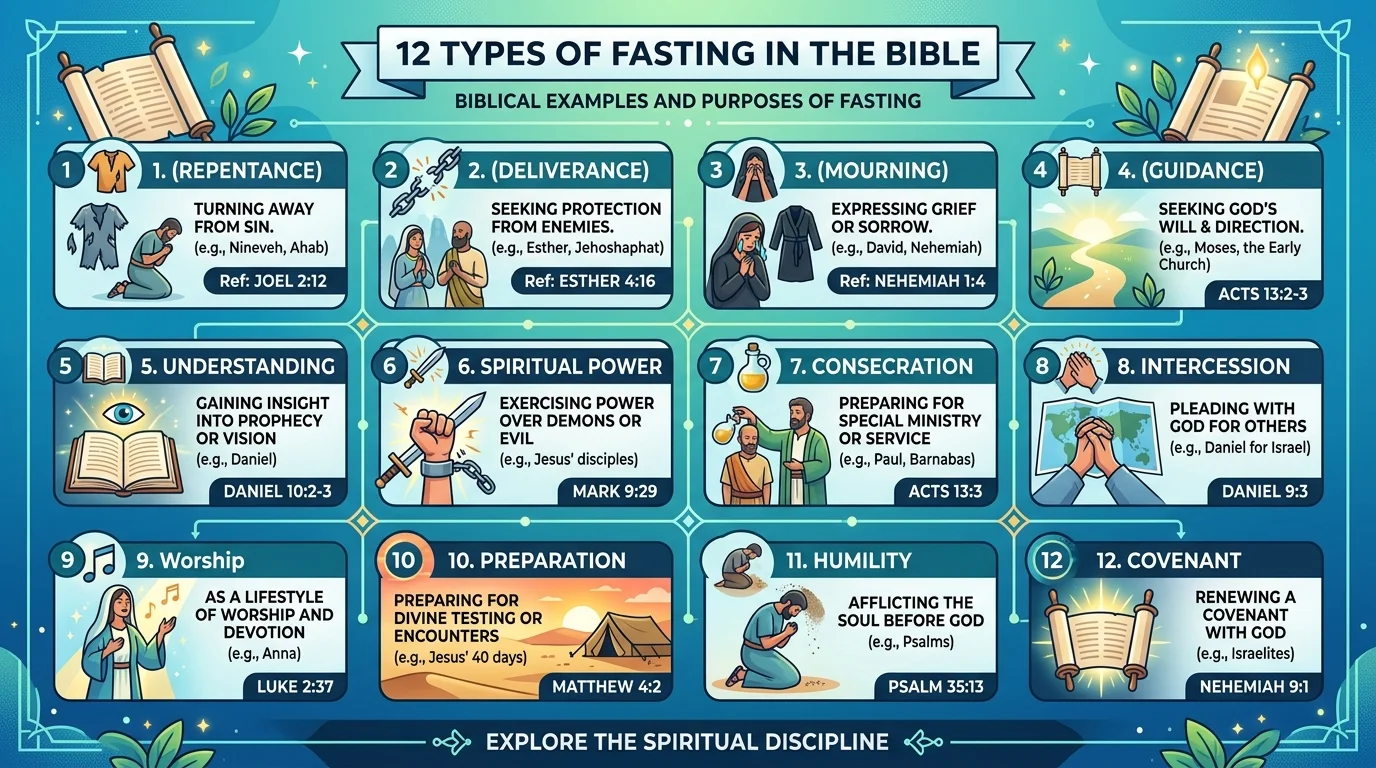
How many types of fasting are in the Bible
There is no fixed number given in Scripture. However, based on biblical examples, most teachings group fasting into 3 to 7 main types, depending on how detailed the classification is.
Types of fasting in the Bible and their meaning
Absolute fast (no food or water)
This is the most intense form of fasting.
📖 Example: Esther 4:16 (KJV)
“Neither eat nor drink three days, night or day…”
Meaning: Total dependence on God in urgent situations.
Normal fast (no food, only water)
This is the most common biblical fasting pattern.
📖 Example: Matthew 4:2 (KJV)
“He fasted forty days and forty nights…”
Meaning: Spiritual focus by denying food but drinking water.
Partial fast (restricted diet)
Also called selective fasting.
📖 Example: Daniel 10:3 (KJV)
“I ate no pleasant bread, neither came flesh nor wine in my mouth…”
Meaning: Limiting certain foods for spiritual discipline.
Daniel fast (vegetables and water style)
A well-known form of partial fasting.
📖 Example: Daniel 1:12 (KJV)
“Give us pulse to eat, and water to drink.”
Meaning: Simple diet to focus more on prayer and God.
Corporate fast (group fasting)
When a community fasts together.
📖 Example: Joel 2:15–16 (KJV)
“Sanctify a fast, call a solemn assembly…”
Meaning: National or church-wide repentance and seeking God.
Private fast (individual fasting)
Done personally between a believer and God.
📖 Example: Matthew 6:17–18 (KJV)
“When thou fastest, anoint thine head…”
Meaning: Private spiritual discipline, not for attention.
Regular or scheduled fast (like “6 to 6 fasting” concept)
The Bible does not specifically command “6 AM to 6 PM fasting,” but people often base timed fasting on verses like:
📖 Judges 20:26 (KJV)
“And fasted that day until even…”
Meaning: Fasting for a set period (sunrise to sunset style) is a practical discipline, not a strict biblical rule.
3 types of fasting in the Bible (simple version)
A simple summary often used is:
- Absolute fast (no food/water)
- Normal fast (no food, water allowed)
- Partial fast (restricted diet)
4 types of fasting in the Bible
Another common grouping includes:
- Absolute fasting
- Normal fasting
- Partial fasting
- Corporate fasting
6 types of fasting in the Bible (expanded teaching)
Some Bible teachings expand further:
- Absolute fast
- Normal fast
- Partial fast
- Daniel fast
- Private fast
- Corporate fast
7 types of fasting in the Bible (full teaching style)
A more detailed breakdown includes:
- Absolute fasting
- Normal fasting
- Partial fasting
- Daniel fast
- Private fasting
- Corporate fasting
- Occasional/situational fasting (for crisis, repentance, guidance)
10–12 types of fasting in the Bible (expanded categories)
When teachers go deeper, they include purpose-based fasting:
- Fasting for repentance
- Fasting for direction
- Fasting for deliverance
- Fasting for spiritual breakthrough
- Fasting for mourning
- Fasting for humility
- Fasting for worship focus
- Fasting for healing prayers
- Fasting for spiritual warfare
- Fasting for seeking God’s presence
- Plus the physical fasting types listed earlier
Key Bible truth about fasting
📖 Isaiah 58:6 (KJV)
“Is not this the fast that I have chosen? to loose the bands of wickedness…”
Meaning: True fasting is not only about food—it is about:
- Humility
- Prayer
- Repentance
- Seeking God sincerely
Simple summary
- The Bible does not give a fixed number of fasting types
- It shows different ways people fasted depending on purpose and situation
- The most important part is heart attitude, not method
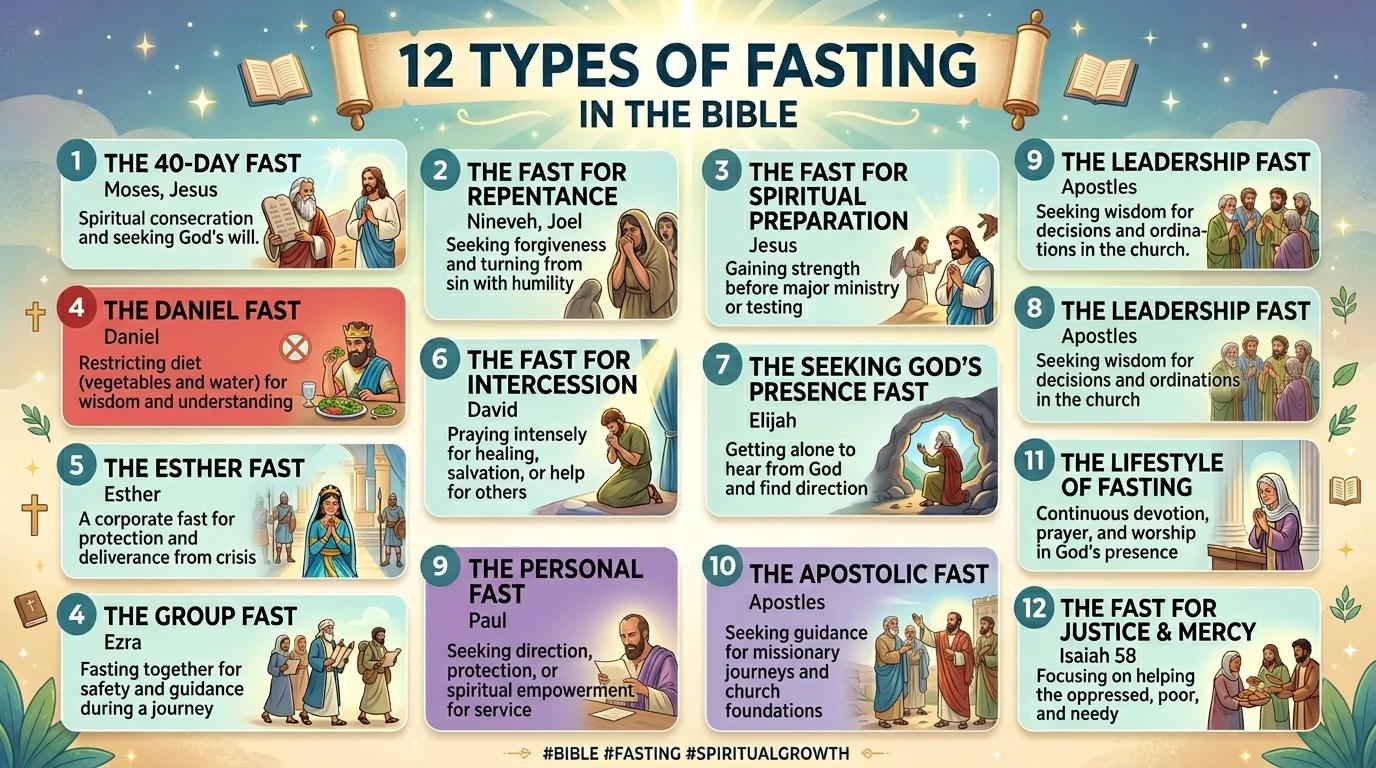
The Total Fast
“For three days they did not eat or drink.” — Esther 4:16
This is one of the most intense fasts, representing complete dependence on God during urgent situations.
The Partial Fast
“I ate no choice food… and used no lotions at all for three weeks.” — Daniel 10:3
Also known as the Daniel fast, this focuses on self-discipline and devotion.
The Day Fast
“I humbled myself with fasting.” — Psalm 35:13
Many fasted from sunrise to sunset, dedicating the day to prayer.
The Corporate Fast
“Proclaim a sacred fast; call an assembly.” — Joel 1:14
Entire communities fasted together for collective repentance or guidance.
The National Fast
“All the Israelites mourned and sought the Lord.” — Judges 20:26
Nations turned to fasting during crisis or national decisions.
The Leadership Fast
“They fasted and prayed, and placed their hands on them.” — Acts 13:3
Leaders sought God’s direction before appointing or sending others.
The Repentance Fast
“Return to me with fasting and weeping.” — Joel 2:12
Fasting was a sign of humility, turning back to God with sincerity.
The Mourning Fast
“They mourned and fasted for Saul and Jonathan.” — 2 Samuel 1:12
People fasted during times of grief to seek comfort and strength.
The Direction Fast
“We fasted and petitioned our God about this, and he answered us.” — Ezra 8:23
Fasting often accompanied decisions requiring spiritual clarity.
The Protection Fast
“He proclaimed a fast to seek protection for the journey.” — Ezra 8:21
People fasted to ask for safety and guidance during uncertain times.
The Healing Fast
“Is this not the fast I have chosen… to break every yoke?” — Isaiah 58:6
This fast focuses on spiritual healing and freedom from burdens.
The Worship Fast
“They were worshiping the Lord and fasting.” — Acts 13:2
Fasting was sometimes practiced simply as an act of devotion and honor.
The Breakthrough Fast
“Some demons come out only by prayer and fasting.” — Mark 9:29
Some fasts were connected with spiritual breakthrough and strength.
The Humility Fast
“I humbled myself with fasting.” — Psalm 35:13
Fasting reminded people of their dependence on God.
The Cry-for-Help Fast
“We fasted that day and there confessed, ‘We have sinned.’” — 1 Samuel 7:6
Fasting often accompanied heartfelt prayer in desperate moments.
The Thanksgiving Fast
“With fasting, sackcloth, and earth on their heads.” — Nehemiah 9:1
This fast combined gratitude, confession, and worship.
The Preparation Fast
“He was there with the Lord forty days and forty nights.” — Exodus 34:28
Fasting prepared individuals for major assignments or revelations.
The Spiritual Focus Fast
“In those days I, Daniel, was mourning three weeks.” — Daniel 10:2
Fasting helped believers focus spiritually and remove distractions.
The Intercessory Fast
“I ate no food… on behalf of my people.” — Daniel 9:3
Fasting was often done for the needs of others, not just oneself.
The Renewal Fast
“Create in me a clean heart, O God.” — Psalm 51:10
Some fasts were connected with personal renewal and spiritual cleansing.
