
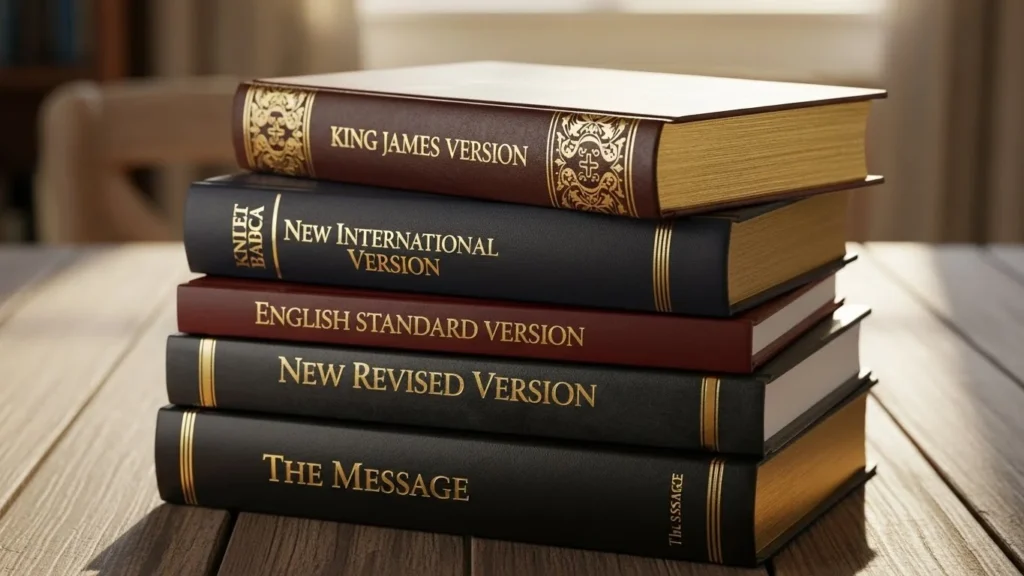
King James Version (KJV)
“Thy word is a lamp unto my feet, and a light unto my path.” — Psalm 119:105
The KJV is renowned for its majestic language and historical influence, making it excellent for traditional reading and memorization.
New King James Version (NKJV)
“Trust in the Lord with all your heart, and lean not on your own understanding.” — Proverbs 3:5
Maintains the beauty of KJV language while updating archaic terms for modern readers.
New International Version (NIV)
“For God so loved the world that He gave His one and only Son.” — John 3:16
A highly readable and accurate translation, ideal for devotional reading and study.
English Standard Version (ESV)
“The Lord is my shepherd; I shall not want.” — Psalm 23:1
Known for word-for-word accuracy and modern readability, widely used in study and teaching.
New Living Translation (NLT)
“Do everything in love.” — 1 Corinthians 16:14
A thought-for-thought translation that emphasizes clarity, great for new readers and personal devotion.
Christian Standard Bible (CSB)
“The Lord is my light and my salvation—whom shall I fear?” — Psalm 27:1
Balances readability and precision, suitable for study, teaching, and personal application.
Revised Standard Version (RSV)
“Let the peace of Christ rule in your hearts.” — Colossians 3:15
Classic translation praised for literary quality and faithful rendering of the original text.
New Revised Standard Version (NRSV)
“Pray without ceasing.” — 1 Thessalonians 5:17
Widely used in academic and ecumenical settings; emphasizes accuracy and inclusive language.
Amplified Bible (AMP)
“I can do all things through Christ who strengthens me.” — Philippians 4:13
Expands meaning of words for deeper understanding; excellent for in-depth study.
The Message (MSG)
“Rejoice in the Lord always.” — Philippians 4:4
A modern, paraphrased version using contemporary language for readability and daily inspiration.
New American Standard Bible (NASB)
“Your word is a lamp to my feet and a light to my path.” — Psalm 119:105
Highly literal and precise, ideal for serious Bible study and research.
Holman Christian Standard Bible (HCSB)
“Blessed is the one who trusts in the Lord.” — Jeremiah 17:7
Balances readability with accuracy; widely used in churches and study groups.
Contemporary English Version (CEV)
“God is love.” — 1 John 4:8
A simple, clear translation designed for modern readers and easy comprehension.
New Century Version (NCV)
“Be strong and courageous. Do not be afraid.” — Joshua 1:9
Uses simple language suitable for children, beginners, or non-native English speakers.
Good News Translation (GNT)
“For God did not give us a spirit of fear.” — 2 Timothy 1:7
Also called Today’s English Version, emphasizes readability and accessibility.
Young’s Literal Translation (YLT)
“The Lord is my shepherd; I shall not want.” — Psalm 23:1
A highly literal translation preserving original structure; useful for advanced study.
Darby Translation (DARBY)
“Faith is the substance of things hoped for, the evidence of things not seen.” — Hebrews 11:1
Faithful to the original languages; less commonly used but valued in serious study.
Lexham English Bible (LEB)
“Trust in the Lord with all your heart.” — Proverbs 3:5
Modern translation designed for research and cross-references with original texts.
Wycliffe Bible (WYC)
“Blessed are the pure in heart, for they shall see God.” — Matthew 5:8
One of the first English translations; historically significant for English-speaking Christians.
Jubilee Bible (JUB)
“In the beginning God created the heavens and the earth.” — Genesis 1:1
Faithful to original manuscripts and considered accurate for Bible study.
Lexham English Bible for Study (LEB)
“Be still and know that I am God.” — Psalm 46:10
Designed for detailed study with helpful cross-references and notes.
Easy-to-Read Version (ERV)
“Rejoice always, pray without ceasing.” — 1 Thessalonians 5:16–17
Designed for children, beginners, and readers who prefer simple wording.
New English Translation (NET)
“The Lord is my strength and my shield.” — Psalm 28:7
Includes extensive translators’ notes for deeper insight; great for study.
The Voice (VOICE)
“Love one another as I have loved you.” — John 15:12
A narrative translation that reads like a story, emphasizing connection and clarity.
Jewish Publication Society Tanakh (JPS)
“Hear, O Israel: The Lord our God, the Lord is one.” — Deuteronomy 6:4
Faithful to Hebrew Scripture; valuable for those studying the Old Testament in context.
Douay-Rheims Bible (DRB)
“Blessed is the man that walketh not in the counsel of the ungodly.” — Psalm 1:1
Classic Catholic translation from the Latin Vulgate, valued for historical study.
Reina-Valera (RVR)
“El Señor es mi pastor; nada me faltará.” — Salmo 23:1
One of the most popular Spanish translations, equivalent to KJV in English.
