
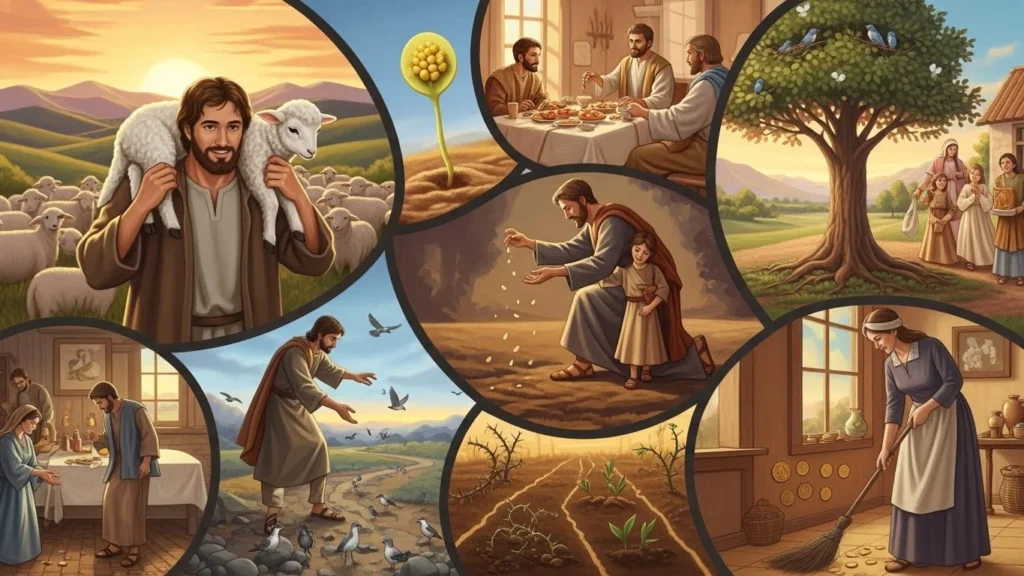
The Parable of the Sower
“A farmer went out to sow his seed…” — Matthew 13:3-9
This parable teaches the importance of receiving God’s Word with an open heart to bear spiritual fruit.
The Parable of the Good Samaritan
“A man went down from Jerusalem to Jericho…” — Luke 10:30-37
A story about love, mercy, and helping others, regardless of differences or boundaries.

The Parable of the Lost Sheep
“Which of you, if you had a hundred sheep and lost one, would not leave the ninety-nine…” — Luke 15:4-7
God values each individual, and His grace seeks to restore the lost.
The Parable of the Prodigal Son
“A son who squandered his inheritance returned home, and his father welcomed him…” — Luke 15:11-32
This parable demonstrates forgiveness, repentance, and God’s unconditional love.
The Parable of the Mustard Seed
“Though it is the smallest of all seeds, it grows into the largest garden plant.” — Matthew 13:31-32
Faith, even small, can grow into something powerful and transformative.
The Parable of the Talents
“To one he gave five talents, to another two, to another one…” — Matthew 25:14-30
God calls believers to wisely use their gifts and responsibilities for His glory.
The Parable of the Rich Fool
“A man stored up wealth for himself but was not rich toward God.” — Luke 12:16-21
Material wealth is temporary; spiritual richness is eternal.
The Parable of the Workers in the Vineyard
“The last will be first, and the first last.” — Matthew 20:1-16
God’s grace and reward are not based on human standards but on His generosity.
The Parable of the Wise and Foolish Builders
“The wise man built his house on the rock; the foolish built on sand.” — Matthew 7:24-27
Faith anchored in God provides stability through life’s storms.
The Parable of the Hidden Treasure
“The kingdom of heaven is like treasure hidden in a field.” — Matthew 13:44
God’s kingdom is valuable beyond measure and worth pursuing wholeheartedly.
The Parable of the Net
“The kingdom of heaven is like a net that caught all kinds of fish.” — Matthew 13:47-50
The parable teaches about judgment, discernment, and the eternal separation of good and evil.
The Parable of the Unforgiving Servant
“Forgive others as you have been forgiven.” — Matthew 18:21-35
God calls believers to extend the grace they have received to others.
The Parable of the Great Banquet
“Many are invited, but few are chosen.” — Luke 14:16-24
The kingdom of God welcomes all who respond to His invitation with faith and humility.
The Parable of the Two Sons
“Which of the two did the will of his father?” — Matthew 21:28-32
Obedience matters more than promises; actions reflect true commitment to God.
The Parable of the Wise Virgins
“Be ready, for you do not know the day or hour.” — Matthew 25:1-13
Preparation, vigilance, and spiritual readiness are crucial for God’s kingdom.
The Parable of the Lost Coin
“A woman searched carefully until she found her lost coin.” — Luke 15:8-10
God rejoices over the repentance and return of each lost soul.
The Parable of the Barren Fig Tree
“Cut it down? No, let it alone this year, and I will care for it.” — Luke 13:6-9
God’s patience and care offer opportunities for growth and repentance.
The Parable of the Sheep and the Goats
“Whatever you did for the least of these, you did for me.” — Matthew 25:31-46
Faith is expressed through compassion, service, and care for others.
The Parable of the Pearl of Great Price
“The kingdom of heaven is like a merchant seeking fine pearls.” — Matthew 13:45-46
The kingdom of God is invaluable and worth dedicating one’s life to pursue.
The Parable of the Wedding Feast
“Many were invited, but the invited did not come.” — Matthew 22:1-14
God’s invitation requires response; neglecting it results in missed blessing.